
Single in the Sanctuary – The Privilege of Marriage

maldives-sunset-wedding-bride-37521-largeUpdated version from my post on September 29, 2016.

In 1996, I was newly independent – living on my own for the first time. While at the time I was in a relationship with someone 90 miles away, I was not married spiritually or legally.

I was changing over my driver’s license, plates, and car insurance.  When I called around to find out insurance rates, I was told that my insurance rates would be considerably higher since I was not married.

I thought about all of my friends who were getting married that year and how they were sharing living expenses with their spouses as well as registering for new items for their house and getting better deals on taxes and insurance.

I suppose that may have been the first time I thought about the privilege of marriage and the slights unmarried people face from time to time.

Now, there are privileged states with each part of our lives.  I don’t necessarily think that being unmarried is a significant marginalization like being an ethnic, racial, gender, sexual orientation or gender/identity/expression minorities.  I am extremely privileged in most ways and do not want to distract people from the serious marginalization that goes on in our communities – from being arrested due to color to being beaten due to religion or sexual orientation.

But from what I’ve seen, heard, and experienced, there is more privilege to being married.  It’s an experience that I have never experienced but friends who are aware of their privilege have noted how they now feel more privileged now that they are married.

Admittedly, I had some feelings bubble up within me when I read Katherine Willis Pershey’s article “Field Notes on Sex and Marriage: Fully naked, fully known” in the September 28, 2016 Christian Century.  (If you want to know a little about my backstory story which was triggered, please see this.)  First of all, I have so much respect for Willis Pershey as a writer, pastor and colleague and have enjoyed her writings.  The progressive/Mainline Protestant community is blessed by her talents, and I want to make sure to lift her up for what she gives to her colleagues and those to whom she is ministering.  I believe it has taken much courage to write some of the things she has written, and I thank her for her vulnerability.

What challenged me is not as much the writer’s perspective on the topic as it is about the lack of another perspective in the publication – a choice most likely by the editors.  I think many of us are on the same page when it comes to making sure that everyone is in a healthy situation when becoming intimate.  I don’t necessarily think a 14, 15, or 16 year old has the emotional and intellectual development to engage in sex at such an early age.  Are they willing to ask the hard questions of their partners before engaging in physical intimacy?  Are they willing to get tested for sexually transmitted infections or make the decisions needed when having an unwanted pregnancy?

Of course, one article can not articulate many clergy’s multi-layered view on the subject of sex, and I think that space was limited from allowing nuances.  But I suppose the way I picked up on the article’s premarital sex perspective is what many of us have heard over and over again: “Now that I’m married, I’m allowed this extra privilege.  You must wait until you are married.”

Just like men should stop telling women what to do with their bodies, married people telling single people what to do with their bodies.  Add sex to the long list of privileges that married people can enjoy – from discounts to companionship to house furnishings.

Again, I don’t want to place the burden on this one writer who has heartfully wrestled with this issue.  She was expressing what worked well for her.

But unfortunately, when a publication decides to only print a common, well-repeated message that has lasted from decade to decade and century to century, those who have faithfully chosen the other perspective are faced with shame once again.

Why I needed to write about this now: single people are tired of hearing what we can and can’t do from another married person, or what we haven’t experienced, or for what we must wait.  With a space like the fairly-progressive Christian Century, I was hoping that it was a safer space for single, divorced, widowed, cohabitating people, and anyone who doesn’t fit into a traditional marriage.  Because they chose not to split the space with a writer from another perspective, it did not feel like a safe space.

We aren’t all ready to marry at 22, or 25, or 30, or even 40.  We consistently and ethically evaluate when the right time to get married because we don’t want to marry at the wrong time, or in the wrong situation, or the wrong person.  We make the best decisions for us – and they’re not always perfect (no one person’s choices are completely perfect).

Many of us make choices throughout our lives to adhere to what is considered the popular Christian ethic regarding intimacy and others of us don’t.  Since shame was the first major thing that divided humans from God, we don’t want to place shame on others so that their relationships with God, neighbor and self is destroyed.

Looking at history, it seems as though people have been restricted from getting married – from slaves in the 19th century to racially diverse couples in the 20th century to LGBT people at the beginning of the 21st century.  It seems as though some people want marriage reserved for some and not other – maybe to keep privilege for themselves.  And even though some are open to marriage equality for all, they aren’t open to marital status equality for those who aren’t married.

If you are a true friend to single people, are you willing to advocate for equal tax breaks?  Are you willing to ensure that their insurance rates aren’t higher?  Are you willing to help them find a way to furnish their house instead of waiting for their magical significant other to arrive and wedding registries to become available?  Will you stop criticizing and shaming them on their relationship and sexual choices, knowing that not everyone can fit in some pretty marriage box?

I don’t think I can no longer sit silent as both conservative and progressive married people continue to “marriagesplain” us on how we should live our lives.  No person of any type of privilege should pigeonhole us and shame us even the slightest into fitting into another’s box no matter who we are on our life journey.

As the church and as faith leaders, please think about how you talk to someone of a different marital status.  How do your words encourage them, validate them as full humans, give them a sense of hope?  How have your words shamed them in the past, and what can you do differently with the next unmarried person you meet?

More needs to be written from the progressive single perspective as there are plenty of writings by married people telling singles how to live – and usually it’s same perspective: be chaste, save sex until marriage, if you don’t wait, you will be damaged.  Yet, single people are authentically wonderful just as they/we are, made in God’s image, and we want to be heard as well.

Willis Pershey is a gracious and open-minded writer who is willing to dialogue with others who hold other perspectives.  We should create opportunities to dialogue with clergy like her on difficult subjects such as sex.

I hope that in the near future I have the courage to read Very Married as I have heard amazing things about it and want to honor her work.  As I read the book, I’ll be sharing some of my “single girl” thoughts here.  At this point of my life, being very single for 43 years, watching everyone I know and love walk down the aisle to privilege, I still find it hard to step into that space.

So I ask all of you today to create spaces for the very married and very single to understand one another.  Until we can create those spaces, we singles will still dwindle in some purgatory until mindsets change or we change to fit into others’ view of what a complete human looks like.

This is an updated version of the post which I wrote last week in response to the Christian Century article.  Katherine Willis Pershey’s article can be found here.  Bromleigh  McClenegan’s response on the Christian Century’s site can be found here.  I would like to give gratitude to both clergy women as they are willing to engage one another and many of us on this difficult subject. 

Single in the Sanctuary – The Privilege of Marriage

Tags

, , , , , , , , , ,

food-couple-sweet-married-largeIn 1996, I was newly independent – living on my own for the first time. While at the time I was in a relationship with someone 90 miles away, I was not married spiritually or legally.

I was changing over my driver’s license, plates, and car insurance.  When I called around to find out insurance rates, I was told that my insurance rates would be considerably higher since I was not married.

I thought about all of my friends who were getting married that year and how they were sharing living expenses with their spouses as well as registering for new items for their house and getting better deals on taxes and insurance.

I suppose that may have been the first time I thought about the privilege of marriage and the slights unmarried people face from time to time.

Now, there are privileged states with each part of our lives.  I don’t necessarily think that being unmarried is a significant marginalization like being an ethnic, racial, gender, sexual orientation or gender/identity/expression minorities.  I am extremely privileged in most ways and do not want to distract people from the serious marginalization that goes on in our communities – from being arrested due to color to being beaten due to religion or sexual orientation.

But from what I’ve seen, heard, and experienced, there is more privilege to being married.  It’s an experience that I have never experienced but friends who are aware of their privilege have noted how they now feel more privileged now that they are married.

I suppose that’s why something did not sit well with me when I read Katherine Willis Pershey’s article “Field Notes on Sex and Marriage: Fully naked, fully known” in the September 28, 2016 Christian Century.  First of all, I have so much respect for Willis Pershey as a writer, pastor and colleague and have enjoyed her writings.  The progressive/Mainline Protestant community is blessed by her talents, and I want to make sure to lift her up for what she gives to her colleagues and those to whom she is ministering.  I believe it has taken much courage to write some of the things she has written, and I thank her for her vulnerability.

What challenged me is the article’s tone towards sex before marriage and the lack of another perspective in the publication – maybe a choice by the editors.  Now, I think many of us are on the same page when it comes to making sure that everyone is in a healthy situation when becoming intimate.  I don’t necessarily think a 14, 15, or 16 year old has the emotional and intellectual development to engage in sex at such an early age.  Are they willing to ask the hard questions of their partners before engaging in physical intimacy?  Are they willing to get tested for sexually transmitted infections or make the decisions needed when having an unwanted pregnancy?

I suppose the way I picked up on the article’s premarital sex perspective is what many of us have heard over and over again: “Now that I’m married, I’m allowed this extra privilege.  You must wait until you are married.”

So add sex to the long list of privileges that married people can enjoy – from discounts to companionship to house furnishings.

Again, I don’t want to place the burden on this one writer.  She should not face the blame of the message that has lasted from decade to decade.  She was expressing what worked well for her.  Unfortunately, to me it seemed as though because it wasn’t good for her, others should live a certain way.

Why I needed to write about this now: single people are tired of hearing what we can and can’t do from another married person, or what we haven’t experienced, or for what we must wait.  With a space like the fairly-progressive Christian Century, I was hoping that it was a safer space for single, divorced, widowed, cohabitating people, and anyone who doesn’t fit into a traditional marriage.  Because they chose not to have another perspective included in the same issue, it did not feel like a safe space.

We aren’t all ready to marry at 22, or 25, or 30, or even 40.  We consistently and ethically evaluate when the right time to get married because we don’t want to marry at the wrong time, or in the wrong situation, or the wrong person.  We make the best decisions for us – and they’re not always perfect (no one person’s choices are completely perfect).

Many of us make choices throughout our lives to adhere to what is considered the popular Christian ethic regarding intimacy and others of us don’t.  Since shame was the first major thing that divided humans from God, we don’t want to place shame on others so that their relationships with God, neighbor and self is destroyed.

Looking at history, it seems as though people have been restricted from getting married – from slaves in the 19th century to racially diverse couples in the 20th century to LGBT people at the beginning of the 21st century.  It seems as though some people want marriage reserved for some and not other – maybe to keep privilege for themselves.  And even though some are open to marriage equality for all, they aren’t open to marital status equality for those who aren’t married.

If you are a true friend to single people, are you willing to advocate for equal tax breaks?  Are you willing to ensure that their insurance rates aren’t higher?  Are you willing to help them find a way to furnish their house instead of waiting for their magical significant other to arrive and wedding registries to become available?  Will you stop criticizing and shaming them on their relationship and sexual choices, knowing that not everyone can fit in some pretty marriage box?

I don’t think I can no longer sit silent as both conservative and progressive married people continue to “marriagesplain” us on how we should live our lives.  No person of any type of privilege should pigeonhole us and shame us even the slightest into fitting into another’s box no matter who we are on our life journey.

As the church and as faith leaders, please think about how you talk to someone of a different marital status.  How do your words encourage them, validate them as full humans, give them a sense of hope?  How have your words shamed them in the past, and what can you do differently with the next unmarried person you meet?

More needs to be written from the progressive single perspective as there are plenty of writings by married people telling singles how to live – and usually it’s same perspective: be chaste, save sex until marriage, if you don’t wait, you will be damaged.  Yet, single people are authentically wonderful just as they/we are, made in God’s image, and we want to be heard as well.

I hope someday I will have the mindset to read Willis Pershey’s book Very Married as I have heard amazing things about it and want to honor her work.  At this point of my life, being very single for 43 years, watching everyone I know and love walk down the aisle to privilege, I don’t think I have enough strength at this moment to do so.  It’s just another painful reminder for me that the very single still dwindle in some purgatory until mindsets change or we change to fit into their view of what a complete human looks like.

Class Reunion Trepidations

Tags

, , , , , , , , ,

meAdmittedly, I weigh more than my last class reunion.  I have additional gray hairs and wrinkles.  My success to failure ratio isn’t all that phenomenal.  I didn’t expand my family in any way since the last time I met with these people.

Basically, my vulnerable, 43-year-old self is heading into the den of expectations known as the class reunion.  And for some reason – maybe nearly reaching some new level of self-actualization – I care slightly less than I did at 38.

I really can’t describe what group I belonged to throughout high school.  I was definitely a band geek with some flavoring of academic nerd and artistic flair.  At the beginning of high school, I was extremely dorky.  Having a father as a civics teacher at the same school didn’t quite help my reputation.  I dated very little – probably due to a unhealthy mix of subpar self-esteem mixed with standing in my strict father’s shadow.

By junior and senior year, I had found my rhythm – identifying with the overachievers at the school, hanging out in G-rated situations and pretty much getting along with most people.

After graduating high school, I lived at home during some summers and holiday breaks.  A few months after graduating high school, I left my hometown, only to return for vacations and occasional nights away from seminary.

Life happened – lots of it, and not in the way I was hoping.  My mom would clip out photos of engagement and marriage announcements and send them to me –  none of which were my own.  I stayed safely away in single-Floridaland while my classmates coupled up and had children.

Sometimes, I challenge my expanding body and nervous soul to attend alumni gatherings in which I see everyone I knew from the days when I was some fantastic 95 pound overachiever with much more of my life ahead of me.

Yet, I think we’re reaching that point when we don’t care as much about how much we haven’t done or how fabulous we are compared to someone else.

We’re reaching the point in which we are just happy to be alive and happy that our friends and classmates are well and still alive.

We’re happy that we’ve all taken time out of our busy schedules and traveled many miles to set aside this weekend to connect in 3D instead of social media.

We are all in our middle years, facing the aging of our parents, their deaths, transitions with our health and understanding that life constantly takes turns for good and bad.  And, yet, we are all still standing.

We are happy to see that many of us have set aside our cans of ozone-reducing hairspray to attain bangs of great heights and chopped off business-up-front-party-in-the-back mullets – although it’s all good if that’s our hairstyles of choice.

We are happy to set aside time to feel like our inner 18-year-olds still exist even when our bodies feel every second of their 43-year-old lives.

I thank my God every time I remember you.  I thank my God every time I can cross the miles to see you.


The Grace Project

Tags

, , , , , , ,

image.jpgI give no grace to myself.

There.  I said it.  It’s been my reality for the 43 years I’ve been alive.  I’ve apologized millions of times for my existence.  My competitive nature does not play well with my graceless attitude because I compare myself with others and then give myself a tough time when I haven’t achieved the same.  I blame myself for not marrying in my twenties or thirties.  I blame myself for not having children or being at the top of my career.  I blame myself for my weight and all of my health issues (most of which I can not control).  I blame myself for the times when I fell short of my goals and dreams.

I blame myself when I forget something relatively small because I forget that I am human.

Because I am so hard on myself, I tend to really rob myself of grace when others give me a tough time about mistakes.  For some reason, ever since I was young, I believed that I needed to be my own worse critic, so when someone else is tougher on me than I am on myself, I raise my level of self-criticism.

I forget that my faith is one that is all about grace.  I neglect to acknowledge that God is pouring copious amounts of grace upon me even as I rob myself of the same. While I am generous in grace with others – mostly because that is the way I would want to be treated – I can not gift the same to myself.

Technically, living in my own critical, graceless head is hell because there is a wall between me and God’s mercy. If hell exists, it can’t be any worse than this, I now think to myself.

There have been times in my past when I’ve noticed that my soul is either filled with rage against me or completely empty.  My soul has lacked love from me, and now is the time to work on filling up that tank with something positive, not the negative it has become accustomed to.

So today I open myself up to the world of my greatest shortcoming: lacking self-grace.  Today, I move towards loving myself, knowing that I will continue to be human and continue to make mistakes.  And sometimes, what I will do will hurt someone else – not because I want it to, but because we all overlook others.  But now when I make those errors, it’s my call to begin the process of forgiveness, to extend reconciliation not only to neighbor but to self.

This new project of mine can be best summed up in the words of Florence + The Machine’s song “Shake It Out”:

And I am done with my graceless heart
So tonight I’m gonna cut it out and then restart

Dear graceless heart, it’s time for you to go.  It’s time to heal from your scars.  It’s time to embrace grace as a way of living.

Single in the Sanctuary -The 50th That Never Will Be

Tags

, , , , , , , , , , , ,

single balloonThere’s a moment in many of our lives when you realize you probably may not celebrate your 50th wedding anniversary.
I’m 43 years old.  Granted, I could live to 95 or 100.  But that is banking on both people in the couple living to 95 or 100.  The average life expectancy is 79.68 here in the United States.  My oldest grandparents were nearly 86 when they died.  I would be ecstatic to live until 86, but that would mean I would “only” have a 35- or 40- year marriage, for which I would be blessed.

And still – not a 50-year marriage.

Our society as well as our churches get excited when we see couples celebrating their 50th, 60th and even 70th anniversaries.  We herald it as the way to live, as the optimal lifestyle.

But what about the people whose lives were turned over by one spouse’s death?  What happens to the wife who needs to leave her husband because the marriage is abusive?  What happens when the husband and wife grow apart, or when one spouse wakes up one morning and discovers their spouse is gone?  What happens to our LGBTQ friends who were only able to officially get married when they were 50, 60 or 70?  What happens to those of us who decide to take our time finding the right significant other because we want quality of years over quantity of years?

When I think of short marriages, Anna the prophetess comes to mind.  Luke 2 says that she “lived with her husband seven years after her marriage, then as a widow to the age of eighty-four.”  After the passing of Anna’s spouse, she dedicates her life to worshipping God in the temple.  Anna’s is a life worth celebrating.  Her seven year marriage was worth celebrating.  The decades of unmarried life is worth celebrating because they were spent answering God’s call.

We should still ABSOLUTELY celebrate anniversaries – like we merrily recognize birthdays and other life milestones and everything happy in life.  But we should not necessarily place quantity of years married at the top of life’s ideal.  Instead, we should place happy and healthy marriages – even short ones – as the goal of marriage (for those who feel called to get married).  We should place our own physical, mental and spiritual health and safety above what society thinks about the length of marriage.  We should place our own calls – whether to be single or married – over one particular ideal marital status.  We should marry when we feel ready to marry, not fitting ourselves into our world’s expectations.

Guess what?  This means many people will never celebrate a 50th wedding anniversary.  And that’s ok.

Churches: It’s our job to make sure that everyone is celebrated whatever they’ve achieved or milestones they have reached.  But we shouldn’t just value long marriages.  We should value relationships that are healthy.  We are called to value people of all marital statuses.  Let us celebrate all of our congregants wherever they are at in their lives and whatever they desire to celebrate.

Single in the Sanctuary – If Disney Made a Movie of Me

Tags

, , , , , , , , , , , , , , ,

imageTrending on Twitter at this very moment is #ifDisneymadeamovieofme.


So what if Disney made a movie about me…

Unlike Ariel, I would have my voice all along and it would have grown stronger.

Unlike Jasmine, I would say who I would marry and when it would happen.

Unlike Belle, I wouldn’t (and didn’t!) stay with an emotionally abusive person.

Unlike Cinderella, I wouldn’t have to fit a mold on what women are supposed to look or be like to attract a man.

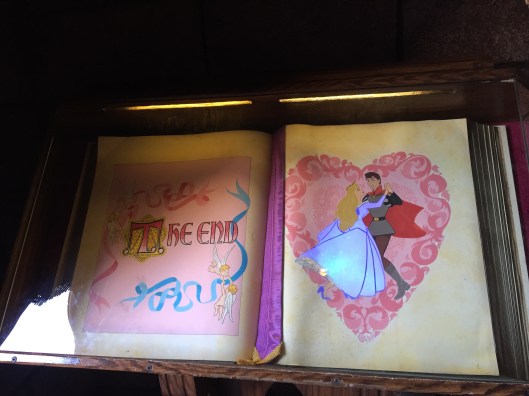
Unlike Snow White or Sleeping Beauty, I wouldn’t need someone to wake me from my tired single days or rescue me from another person.

Instead, I would be the princess who wore flannel and t-shirts around the house, said what I thought, and rid myself of toxic people in my life. I would not lose myself in an attempt to find or keep a man.

Sure, there was a time when I believed in Happily Ever Afters. But we discover as we age that there is not one formula for being happy. There are both single, divorced and married people who are happy, and those of all marital statuses who aren’t. Being married does not guarantee a Happily Ever After just as being single does not mean we are incomplete.

If Disney Wrote a Story About Me, there would not be a Happily Ever After… just a Happily in This Moment.

Single in the Sanctuary – The “Love Yourself” Photo Challenge

Tags

, , , ,

A number of my friends are participating in a “Love Your Spouse” photo challenge.  What this entails is that each day for a week, the individual will post a photo of them and their spouse.  It’s a cute activity in which many friends enjoy participating.

For many of us, we can’t participate in this activity.  Some of us have never been married.  Other have gotten divorced.  The photos aren’t available from people like me.

So, in order to begin a new tradition, I am starting a “Love Yourself” photo challenge.  This challenge is one that embraces the mandate in the greatest commandment “love your neighbor as yourself.”  It forces each of us to recognize the Divine image within ourselves – no matter who we are related or attached to.

And it is inclusive of all people – no matter their marital statuses.

I bring you my seven “love myself” photos below.

Fontbonne University Homecoming Dance – Fall 1992

image

Many of my interesting stories begin with “when I was 19.”  In the fall of 1992, I was 19 years old, very single and very much enjoying life.  I believe this was the only time in high school or college in which I attended a formal dance on my own.  And I still had a blast.

Philadelphia – Summer 1999

image

In this twentieth century selfie, I joyfully mark a trip in which I navigated around a city on my own.  Before GPS on cell phones were a thing, I utilized a paper map to find various landmarks around Philadelphia.  Through this experience, I gained a sense of freedom and confidence and have continued to traipse around big cities on my own.

My Sister’s Wedding – Fall 1999

image

There is nothing easy about going to your little sister’s wedding when (1) you are not married and (2) don’t have a date to the wedding.  But I went.  I stood next to her as maid of honor, gave a toast and still walked away with my dignity.

Washington D.C. – Spring 2008

image

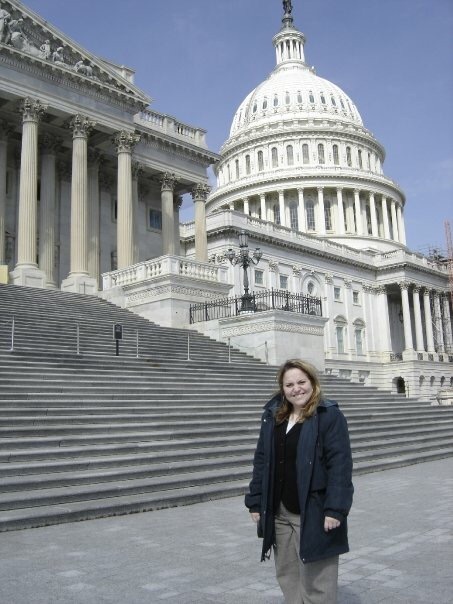
Here I am at Ecumenical Advocacy Days, a progressive-Christian annual event to discuss justice issues.  On the last day of the event, I met with representatives of my congressional leader and senator.  In those moments, I advocated for various justice issues – specifically women and intimate partner violence.  Advocacy work energizes me as I believe it can make a difference.

Eden Theological Seminary Graduation – Spring 2010

image

After years of hoping and dreaming of completing my Master of Divinity degree, I reach my successful end point on May 14, 2010.

Ordination to Ministry in Dunedin, Florida – March 6, 2011

image

One of the biggest days of my life is represented in this photo.  Not only am I being ordained, I am celebrating the sacrament of communion at the table for the first time.

UCC General Synod 30 – June 2015

imageAfter writing a chapter in the book There’s a Woman in the Pulpit, I was a part of my first group book signing at the UCC General Synod in Cleveland.  Being a writer and becoming published is another lifelong dream and call which is represented here.  Thank you to Eden Theological Seminary for this photograph.

So single, married, divorced, widowed, separated and cohabitating friends – I challenge you to post your seven photos that represent your greatest self.  In doing so, remember that you are made in the image of God no matter who you are related to or what you still dream of achieving in your life.

Single in the Sanctuary – For the Record, I’m Fed Up Too

Tags

, , , , , , , , , , ,

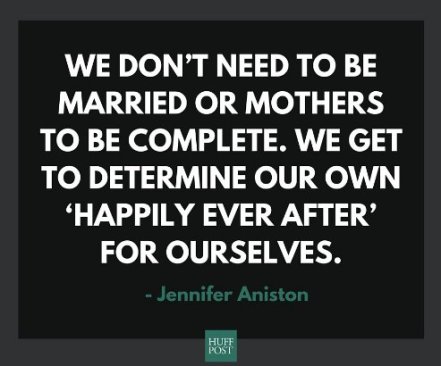
aniston memeThis week, brave shero Jennifer Aniston wrote this brilliant op-ed on the Huffington Post regarding her frustration with the media for scrutinizing her body and family structure.  She has previously spoken out on these frustrations and chose to write a public post after some elaborate false reports that she was pregnant were plastered all over the internet.  In her most recent piece, Jennifer noted:

Here’s where I come out on this topic: we are complete with or without a mate, with or without a child. We get to decide for ourselves what is beautiful when it comes to our bodies. That decision is ours and ours alone. Let’s make that decision for ourselves and for the young women in this world who look to us as examples. Let’s make that decision consciously, outside of the tabloid noise. We don’t need to be married or mothers to be complete. We get to determine our own “happily ever after” for ourselves.

While the interrogation of my life never usually includes whether or not I’m pregnant, there are similar questions circling me whenever I’ve been in a significant relationship for a while:

Have you started talking about getting married?
Do you think you two will get married someday?
Do you think he wants to get married someday?
When do you think you’ll get married?
You think he’ll propose during (fill in the blank)?

Admittedly, being interrogated like this was much much worse in my early 20’s when everyone around me was pairing up and getting engaged.  When I wasn’t dating, I was being grilled with the “are you dating someone” questions.  And if I was married, I would be asked when I would be starting a family.

All I want to say in my increasing anxiety and frustration is “BACK OFF!”

Now, I don’t mind a question like this from my six year old niece because children have no filter to their curiosity.  But a thirty, forty or seventy-something should know better.

I get it: people really want to see me get my “happily ever after.”  Or maybe they are just curious.  Or maybe there are one or two people out there who really want to know how my life has not come together.  Who knows…  Overall, it makes me feel invaded, odd and, in many ways, shamed for what I have or have not done yet with my life.

I must confess that I’ve taken part in a system that places expectations on other people.  I read tabloids that steal moments and fabricate stories about celebrities.  I’ve asked people about the relationship in the past.  And for being a part of a system that tries to pigeonhole women, I am truly sorry.

Almost two years ago, I wrote this post about Jennifer Aniston and her frustration with this checklist everyone thinks she should have accomplished.  Yesterday, I watched a video of the “Magnificent Seven,” or the seven U.S. women gymnasts who won the gold medal for gymnastics in 1996.  They were all in one place, updating the world on their lives and reflecting back on their stunning achievement.  As one of the Olympians stated “Twenty years later, it’s good just to see that everyone’s happy, everyone’s healthy, everyone is married (and) either starting families or have families of their own.”

What if they hadn’t all gotten married or planned on starting families?  Would they have been incomplete as an individual or a group?

It comes down to what we believe full completion is in a human being – especially a woman.  It isn’t enough that she just is a human being caring for other human beings in the world.  It isn’t enough that she is made in the image of God.  She must also be married and have children.  And we will keep asking those questions and begging to read more until her life finds this level of completion.

Jennifer and everyone else, I’ve grown tired of this narrative too.  I’m tired of feeling like I need to explain or justify to people the progression of my relationship.  I’m tired of trying to fit into the world’s expectations of what I should have accomplished by 43.  It’s no one’s business except mine, my significant other’s and God’s.  When the time is right, we will take our relationship to the next step…

You know what?  I don’t even need to say that.

And like Jennifer, I will be the one to tell you when I’m engaged or when I’m getting married.  I will be the one who tells you when anything big happens in my life… if and when I feel like it.  Like Jennifer, there are things I want with my life as well.  But life doesn’t happen in a prescribed time, and sometimes we just want to live without the painful reminder of what we should have.

Every time one of these questions pops into our heads about our cousins, co-workers or celebrities, maybe we need to change focus.  As Paul says to the Thessalonians “we urge you, beloved to (love) more and more, to aspire to live quietly, to mind your own affairs…”  It’s time for us to love one another where we are at right now without setting our minds completely on the future and what they may or may not bring.

In the meantime, I will work to enjoy the valuable small moments in life – with my significant other, with my friends and with myself.  Life isn’t about waiting for the big moments.  It’s about cherishing the sunshine in between the clouds.


Pokémon Go, Reloading and Sabbaths

Tags

, , , , , , , , , ,

image

Apparently, our church is a Pokémon Go PokéStop.

What does this mean?  While I’m new to the game, I believe a PokéStop is a location where people can reload on supplies they need to capture the monsters.

My church, St. Paul United Church of Christ in Colerain Township, Cincinnati, is a PokéStop.  At first, I didn’t know this, and I’m not exactly sure how we became one.  After watching a few new people walking around our church building and then installing the app myself, I can indeed confirm that we are a PokéStop.

While church may not be a destination for younger people, PokéStops are.  So how can we merge virtual life and spiritual life into one location?

Remember the Sabbath.

Times and spaces to reload are important for all people.  Some choose faith communities.  Others choose sporting activities, arts or fellowship activities.  These are activities that give something back to our souls.

Church was already a PokéStop in the game of life.  It has been and should always be a place in which we can recharge our batteries and reload on spiritual energy for the new week.  Sometimes we get away from the idea that Sabbath is for reloading on spiritual fuel.  While we may come to church to give to God, we are also finding supplies for our soul.  God gave us the Sabbath for us to find renewal.  As Jesus says in Mark 2, “The Sabbath was made for humankind, and not the humankind for Sabbath.”

In our time of reloading, or Sabbath, may wee all see God a little clearer, each other with more love, and find spiritual supplies to help us manage life throughout the week.


Single in the Sanctuary- Eating Alone

Tags

, , , , , , , , , ,

imageI remember when my sister would see an older man or woman sitting alone. She and my mom would remark how sorry they felt for that elderly person dining by themselves. Maybe there was an energy surrounding them that reflected sadness.

Does there exist a lack of sadness for the thirty or forty year old who eats alone? Did an older person’s more-likely involuntary solitude beg for more empathy? Are younger people looked as having more resilience or is there a mentality out there that we are somehow defective or choose to be alone or fully content in our solitude?

I’ll say this: sometimes solitude is welcomed, even by this extrovert. Nowadays, we have the beauty of smart phones to give us the look of preoccupation in our aloneness. But sometimes the silence of solitude is so overwhelming that I ache from the lack of conversation.

I don’t want to be pitied for my solitude as my life is fairly full. But I wonder: does a person whose age is far greater deserve more empathy? Maybe so- especially if they just recently lost a spouse or partner. While sometimes the only option is eating alone, but do those of us who settle for solo meals sell ourselves short by settling for company-less dinners and lunches?

For faith communities: What can we do as a church so that solo people of all ages have the company they desire for more of their meals?